Wednesday, May 16, 2012

Round Table #1: Josh Beckett's back-injury and golf

[Context: Two weeks ago, Josh Beckett was scratched from a start due to back-tightness. Last week, it was revealed that he subsequently went golfing. In his own defense, Beckett explained that he often golfs on off-days and it's never been an issue before. For those keeping track, Beckett was also the reputed "leader" of the group of Red Sox at the center of last season's drinking-beer-in-the-clubhouse-during-games controversy.]

Photo by Jeff Haynes, Reuters


Derek:

Insofar as Beckett's pursuit of (drinking and) golf interferes with his job, it is assuredly a problem.  I mean, if golf (and/or alcohol) interfered with my job, I'd be fired and Beckett makes far more money (for a far less meaningful 'job').

That said, proving that his baseball troubles stem from disinterest and/or distraction is another matter entirely.  Thus, the converse also holds: insofar as they are not interfering with his ability to do his job, the public outcry is potentially unfair.  More often than not claims of disinterested play seem to come about in bi-directional fashion (see Yunel Escobar).  That is, teams with rules/standards/practices that don't connect well with a given player's demeanour (much like management disconnect from staff in many workplaces) fails to generate a substantial return on investment.  Often when struggles arrive, press, fans, managers grasp at straws:  Beckett is struggling at baseball while golfing a lot, therefore golf must be the problem.

However, Josh has every right to golf and perhaps we should simply stop at the first clause ("Beckett is struggling at baseball.")  Golf, alcohol, personal problems aside, when most players struggle to this degree changes are made (trades, demotions, placed in bullpen or on DL, etc) but it seems to me that placing the blame on Beckett's non-baseball activities does little to resolve the problem.
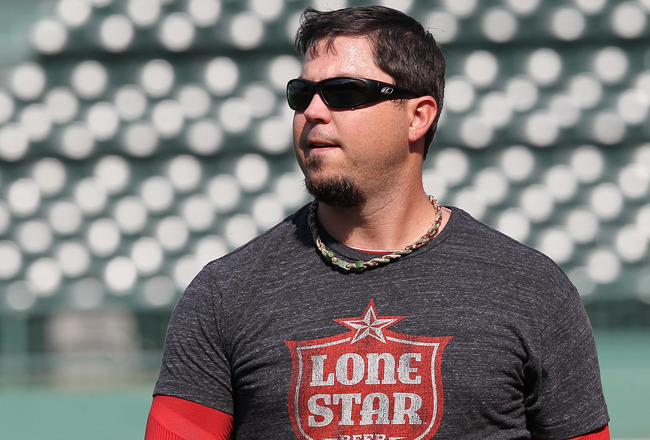
Photo by Jim Rogash, Getty
 
Nathan:

It is tempting to unite with Boston fans and media in indicting Josh Beckett for playing golf during the season, particularly on the heels of last year's chicken and beer fiasco. After all, pro athletes like Beckett make a relative fortune playing a game many of us pay to play in our leisure time. Tempting as it might be, however, it isn't fair.

The disciplinary structure of high performance sport instructs athletes to understand their bodies as machines. That is, it encourages a dualistic approach that separates the mind from the body and positions the latter as inferior and thus subordinate to the former. This is an instrumental approach to the body that makes it possible to treat it as a weapon in violent sports that can inflict harm on the other, and, slightly more benignly, as a tool to be manipulated by the mind in others like baseball. Part and parcel of this dualism is the notion that the body must be cared for like a machine--it must be fed, watered, and conditioned to achieve optimal performance. Like a machine, however, it also means that the body is disposable. It is a means to and end, and that end is ultimately more important than the costs accrued to achieve it. Thus, the athlete is exhorted to destroy the body in the quest to win for the team, and for the fans who vicariously find meaning through the team.

So, why this abstract meditation on the culture of high performance sport? What does it have to do with Beckett? My case is that athletes like Beckett should be encouraged not to see their bodies in such instrumental terms. By playing golf, Beckett reveals a more playful understanding of his body. His lack of concern over how to optimize its performance suggests that he has not been entirely socialized into this damaging culture. While this may mean he suffers injury in the short term, it may also mean that he is less willing to subject it to extreme forms of harm over the long haul. It also models for other, younger, aspiring players that there are different ways to approach sport. Like, for instance, as if it was just a game.

No credit found for this one, unfortunately!

Neil:

I'm a big fan of Dirk Hayhurst - relief pitcher (former Blue Jay!), blogger, memoirist, and fantastic Tweeter - and, in thinking about Beckett, I'm going to draw a bit of inspiration from his own ruminations on this topic.

A career-minor leaguer, Hayhurst has made a whole 25 appearances at the big-league level, (and, barring a miracle, won't make another) and is unapologetically honest when it comes to talking about the stresses and pressures that come with being a pro athlete. So, when Hayhurst is asked to either tell kids that they should 'play for the fun/love of it', or is criticized by fans/parents/coaches because his writing is too serious and shows that he doesn't just 'play for the fun/love of it', he inevitably disappoints them. Because, for Hayhurst, it isn't particularly fun - it's his job, (both the baseball and the writing that it inspires) he has responsibilities to his team and the fans, and it's how he feeds his family. But he also talks about the moment where pros admit to 'not caring anymore', and by this he doesn't mean that they stop playing hard - he means that they accept that their careers will eventually end and they need to have something more going on in their life.

So, where am I going with this? I can't help but feel that some of the animosity has to do with the bizarre expectation that athletes must be 100% committed to their sport, every single moment of every single day, at least during the season. We have this weird expectation of pro athletes that suggests that proper "discipline" or "focus" requires complete devotion, if not unhealthy obsession. But playing other games, showing interest in other things? This is good. Beckett needs to be doing these things for himself, owes it to himself to live a balanced life and develop a wide range of skills and interests, because his baseball career will be over before the end of the decade.

But the baseball job? Like Hayhurst says, Beckett isn't just doing that for himself. And to the extent that golf could easily lead to an injury that affects his ability to pitch, it's a bad idea. (It's possible that Beckett has a technically sound golf swing and that his swing coach and doctor are in agreement that the muscles he uses in his swing are not the same muscles that he injured pitching. But I find that kind of forethought very unlikely.) It has nothing to do with optics, (although, certainly, it does look bad) and everything to do with living up to the responsibility he has to others - his family, his teammates, the people of Boston. (And, I begrudgingly admit, to the guys who directly employ him. They do, after all, owe him another $45 million, give or take a couple million bucks.)

Sunday, May 13, 2012

Chief Wahoo and racist myth-making: an FAQ, of sorts

A couple weeks ago, I read a really nice piece by Peter Pattakos in the Cleveland Scene. (You should probably check it out.) In it, Pattakos talks at length about the Cleveland Indians' mascot, Chief Wahoo, the origin of the "Indians" team name, and the politicking that has surrounded the two for the past few decades. Needless to say, the author is soundly on-side with the anti-Wahoo folks who rightly deride it as horribly racist and unnecessary. And, needless to say, the comment thread quickly filled-up with people - some of whom obviously hadn't actually read the article - who came up with all sorts of, let's face it, patently stupid defenses of Chief Wahoo.

So, without further ado, here are some of those myths - some stupid, some not so much - debunked in what I hope is a much easier-to-consume form.


Myth #1 - The baseball team was given the name "Indians" in 1915 out of respect for Louis Francis "Chief" Sockalexis, a Native American who played for the Cleveland Spiders in the 1890s.

Well, actually... the name was meant to evoke the stereotype of the savage, blood-thirsty Indian of the then-recent Indian Wars.

Peter Pattakos covers this one adeptly in the article, but it bears repeating. To quote Joe Posnanski, "Why exactly would people in Cleveland — this in a time when Native Americans were generally viewed as subhuman in America — name their team after a relatively minor and certainly troubled outfielder?" Sockalexis wasn't even liked by the Cleveland fans, who were known to shout racist slurs and throw garbage - and this guy played for the home team. The Indians' nickname was, in fact, originally given to the team by the 1890s journalists who jokingly (that is, mockingly) referred to Sockalexis' entire team as "Indians". When the team adopted the name at the behest of the next generation of journalists in 1915, contemporary stories include zero references to Sockalexis but numerous mentions of racist stereotypes, like the suggestion that the team will be "on the warpath all the time, and eager for scalps to dangle at their belts". But don't take my (or Pattakos') word for it:

From The Cleveland Plain Dealer, 1915.


Myth #2 - Chief Wahoo represents old-time baseball and childhood memories of trips to the ballpark, not actual Native Americans.

Well, actually... it can be, and is, both about old-time baseball (and all the baggage that old-time baseball carries) and actual Native Americans.

First, nostalgia for its own sake is always a pretty weak argument. Don't just say that it's good because it's old and familiar and you remember it fondly. Resorting to an 'it's tradition!' argument doesn't actually explain why it's a good thing. Second, the way that nostalgia idealizes the past is especially problematic, here. When we choose to remember or recognize only the good, we have to conveniently ignore the bad. Like, in this example, the memory of the shitty treatment given by the city of Cleveland to Sockalexis, their supposed inspiration. Because, let's remember, old-time baseball was also about excluding or alienating everyone who wasn't white.


Myth #3 - Whether you see a racist caricature or not is a matter of individual perception. It's all relative, so don't force your opinions on me.

Well, actually... just because it's relative doesn't mean that every opinion is equal, especially when the people who don't see a caricature are often operating from a position of blissful ignorance.

Whenever someone uses "relative" this way, they deserve to be slapped, because it's being used in an incredibly reductive way in order to imply that if something isn't a fundamental law of the universe - ie. the definition of "racist" or "offensive", as opposed to the chemical composition of water - then it's entirely up for grabs. Only, that's not actually true, and history and social consensus can't just be dismissed without consequence.

Take, for instance, the colour blue. Now, I could start referring to the colour blue by the name "red". And you might find that endearing, at first. But you would probably tire of it, eventually, and you might even grow concerned if I didn't stop, and either start correcting me (because I'm either colour-blind or, I suppose, an idiot) or refer me to a doctor (because I've lost my mind). In any case, even though the combination of the colour and its name are totally unmotivated and relative, that doesn't mean that they can be ignored at will and without repercussion.

So, whether you see a racist caricature has a lot to do with whether you're conscious of racist caricatures and their history - you don't need to know what a Sambo character is, or what they look like. I don't think that you need to be aware of how degrading Sambo-type caricatures were intended to be, how much pain they caused, and exactly what defined their appearance. Because you can just look at Chief Wahoo and the Indians logo and easily recognize that this isn't a flattering representation: knowing nothing else, you can be certain that it's unrealistic, pretty sure that it's comedic, and relatively confident that it's mocking.

Aaron Sechrist's comparison of Chief Wahoo to a Sambo caricature


Myth #4 - People who are offended by Chief Wahoo take themselves too seriously. They should worry about more important things.

Well, actually... "important" is relative, too.

If you identify as a member of a group that has historically been mocked and/or villified - and made to feel less than human for it - you'd probably be sensitive, too, when a pro sports team continues to shove that in your face and tell you that your opinion and feelings don't matter. What's not important to you, personally, could be incredibly important to someone else.

So, there's an empathy problem here - a lot of white fans, for instance, are able to say this because they can't relate to the feeling. Which is probably why someone made this logo:

T-shirt from Shelf-Life Clothing Co.

And let's be careful with our use of the word "important", especially to avoid being inadvertently ironic. Because if we're saying it isn't important because people are children are starving somewhere, then surely a bat-and-ball game played by millionaires, who are employed billionaires, isn't important either, right? And if a ball game isn't important, then neither is Chief Wahoo - why not just change the damn logo?


Myth #5 - But some Aboriginal/Indian/Native people are fine with it, so it must be okay.

Well, actually... no one person, or group of people, can speak for everyone. And we aren't always conscious of the ways in which we're being oppressed.

But it's also true that we ignore or excuse a lot of inequality, even when it affects us directly. Purely as a defense mechanism, we don't want to believe that racism or sexism or homophobia exists. Even when we're victims of these processes, we often don't see them - in part, because seeing them would require us to see that we're complicit in processes that similarly discriminate against other people and benefit us.

And if that doesn't convince you... just think of every time you played pick-up sports as a kid, where your team lost the argument if one of your teammates agreed with the position of the other team. Regardless of the facts, that was always the deciding factor. It was dumb, but it was forgivable, too, because you were all just kids and your solution didn't necessary have to be logical. Adults, though, need to be held to a higher standard.

 
Myth #6 - If the logo is racist, then that makes everyone who likes it racist. So, you're calling me a racist.

Well, actually... plenty of people unknowingly do and say racist things all the time, often without any awareness of it.

My favorite anecdote on this topic came from the first summer that I worked in a government office. One of my co-workers, who was reviewing my work, said that I didn't have to worry because, and I quote, "I'm not gonna Jew ya." And she had no idea that the verb, 'to Jew', had anything to do with Jewish people. No, seriously. (In her defense - I grew up in Sudbury, which, according to the 2006 census, is 93% white. Ignorance of obviously racist things is pretty common.)

The real problem is when you know the arguments, you've heard the evidence, and you just ignore it all.


Myth #7 - The logo's not racist.

Well, actually... if you're still saying that, I'm hoping it's because you didn't bother to actually read this article. (Or that you're illiterate.)

Friday, May 11, 2012

Solving the beanball problem

Okay, so my title is begging the question: is there actually a "beanball problem" in baseball? I'm taking it for granted that there is, and that you agree with me. (This is inspired, of course, by the Cole Hamels-Bryce Harper controversy from less than a week ago.)

Hamels explained that he threw at Harper because the latter is a rookie, and because
Hamels' plays "old school". Reportedly, Hamels also kicks opponents in the groin and grabs
runners by the belt, just like Ty Cobb did. Old school! Photo from The Washington Post.

The hit-by-pitch in baseball is, to some extent, unavoidable. In the last 60 years or so, Major League Baseball has averaged a bit less than 0.5 hit batters per game. (And that 0.5 includes both teams - so individual teams' pitchers hit one batter every four games, and one of their own batters is hit by opposing pitchers once every four games. And that includes intentionally hit batters, which surely inflates the number a bit.) Even pitchers who have a reputation for being particularly wild or willing to throw inside only hit one batter every 20 innings - and normally, 20 innings would be spread over three starts.

So, what I'd like to suggest (y'know, for all those baseball executives who read this blog) is a yellow-card/red-card system for pitchers who hit batters. It would look something like this:
  • if you hit 2 batters in the same inning, you earn a red-card and are immediately ejected
  • if you hit 2 batters in different innings of the same game, you earn a yellow-card
    • [assuming that you don't later earn a red-card, that yellow-card stays with you for the next 7 days]
  • if you hit a 3rd batter in the same game, you earn a red-card and are immediately ejected
  • if you enter a game while having a yellow-card from a previous appearance, your 1st hit batter  extends it for another 7 days
  • if you hit a 2nd batter in the same game, you earn a red-card and are immediately ejected
  • every red-card is subject to automatic review to determine whether an additional suspension is warranted
  • after your first red-card of the season, every additional red-card carries an automatic 7 day suspension, plus a review to determine whether an additional suspension is warranted

I think that covers the ground that it should cover, but I might be missing something. The idea, though, is to provide enough of a penalty that pitchers might try a little harder to avoid hit batsmen, while at the same time not doing so much that pitchers would be afraid to throw inside. (Unless, of course, they have a yellow-card against them. In which case, they probably should be a bit afraid to throw inside. But that's just how penalties are supposed to work.)

There's one obvious gap in my logic, though, which is that it might actually incentivize batters to lean into a pitch, or simply not get out of the way. I'd like to think that most batters aren't that dumb - letting an 85-95 mph ball hit you, in any part of your body, is probably a bad idea. At the same time, we know that happens, and some batters - I'm thinking of Larry Walker - were particularly good at "turning away" from the ball in such a way that they actually increased the likelihood that they would be hit.

For that reason, any beanball that resulted in a yellow or red-card would be subject to video-review after the fact - and the card would be rescinded if the reviewer found that the batter didn't actually make an effort to get out of the way. (Also? Let's starting calling batters out when they don't actually try to get out of the way. Because I'm not sure that I've ever seen an umpire do that.)

Wednesday, May 9, 2012

"Money puck": when bad sports research attacks

My University of Toronto email account gets these periodic bulletins with all sorts of random info about what's happening at the school and faculty or students who have been in the news. This story popped up in the last bulletin, and while the headline filled me with skepticism - the shamelessness of "Money puck" is almost too much to bear - I was genuinely interested in the research that this engineer, Tim Chan, and his student, David Novati, were doing. [Full-disclosure: I actually work for the University of Toronto. In Engineering, no less.]

Quick - which one is the student and which the professor? Photo by Raj Grainger.

Having read the article and their second paper, I realize now that I probably should've skipped the whole thing. But I didn't, so you're going to hear about it.

The fluff piece immediately throws up a bunch of red flags. The authors explain that their study confirms that Sidney Crosby is a valuable player (really? someone who's regularly compared to Gretzky is good? what a surprise!) and that guys who get in fights and rack up penalty minutes are not valuable (it's bad to give the other team a power play? another shock!) So, unless this study is meant to be read by people who only listen to Don Cherry, it's immediately difficult to see what they're adding to the conversation.

An aside: One of the complaints that Tom Tango makes about academics who wade into statistical sports analysis - apropos of nothing, I think that this is too often the case with my other research interest, comic books - is that they don't bother to check the non-scholarly research, first. And this is a huuuuge problem. Because, y'see, the work that these academics are trying to do - "quantify[ing] [each player's] individual contributions to his team’s performance" - has been done and is being done, and very well. (And we know it's being done well because, as with many of the baseball analysts, their work wins them jobs with pro teams.) Here, for instance. And here. And this one, which is one of my favorites because it's surprisingly accessible. Also, here. Here's another one. This one, too. And here's a slicker option that's also pretty readable and very comprehensive. And one more. (To Chan and Novati's credit, though, they actually referenced the very last site on this list.) But academics ignore them, because that's the nature of the game - you reference other academics because they have academic prestige, thereby increasing your own academic prestige; and then you hope that other academics will reference you, increasing your prestige again.

Ryan Miller and Jim Corsi. Corsi's name should appear somewhere in this paper.
It doesn't. And that's a bad thing. Photo source unknown.

So, when their abstract begins with reference to "[r]ecent literature in hockey analytics" and it references only one non-academic advanced statistics site? (Which is, hilariously, equal to the number of references they make to both Bill James - who has nothing to do with hockey - and their own work.) That's a bad sign that, no, they aren't familiar with what's happening in the recent literature. (Or that their definition of "recent literature" is much too narrow.) And when the first line of your abstract is just plain wrong...

Some other (not-so) quick and dirty comments:
  • From the abstract: "Top ranked players in terms of point shares tend to be winners of major NHL awards, are leaders in scoring, and have the highest salaries. ... Overall, a better understanding of individual NHL player characteristics may provide a foundation for deeper, data-driven player analysis." Okay, so I don't get it. Why do we need "deeper" analysis if, in the first sentence, you're saying that your top-ranked players are also the ones who win awards and get paid well? Doesn't that imply that the current evaluation system works just fine? That you can add nothing to it? There's no hook, here.
  • They reference their earlier paper, which uses k-means clustering to establish four player types. Now, admittedly, I know virtually nothing about algebra. But I can tell when someone's approach is begging the question. What benefit does clustering actually have, here, to a game that is determined solely by goal-count? Where does the need to establish "types" come from and what point does it actually serve? And why limit yourself to, for example, four clusters of forwards and define them in the way that they have? I suspect that it's because most teams use four lines of forwards, each characterized by those particular functions (two scoring lines, a defensive line, and a "physical" one), but this is exactly the kind of "traditional" thinking that needs to be challenged, (or confirmed) not taken as a given.
  • This is more of a personal preference, but I've never been sold on Win Shares or Point Shares. (Nor has most of the advanced stats community, since most sports seem to prefer some version of Wins Above Replacement.) Especially in a sport like hockey, where 10% of your team's points may be derived from shoot-out wins, team wins and points simply aren't the best way to evaluate individual talent-level. (Also, given the point I just made about shoot-outs, you'd think that they'd incorporate shoot-out stats into their analysis. But they don't.)
  • They use only the most obvious, traditional stats. Now, goals make sense (though shooting percentage is better, and they should also account for the difference between even-strength and power-play goals, because the latter are so much easier to attain), but it's horribly problematic to use assists without differentiating between the quality of different assists - earning the second assist often means you had no direct involvement in the goal, or at least you were just as involved as the guy who fed you the puck but didn't earn a point himself. They use penalty minutes but, at least, admit that this is to help determine the player's function, not because penalties are good. (This is where the analysis is unclear me - is the "physical" component actually a negative component?) And they use plus/minus, which is where I start to feel The Outrage boil up. Plus-minus is a terribly way to assess a player's value - just click on that link, which explains why the best defensive players routinely have terrible plus/minus ratings. And then The Outrage explodes when I see that they use unadjusted GAA and... Goalie Wins. Um, no.
  • Relatedly, they completely ignore all of the tremendously useful advanced stats that have appeared over the past decade: they never use the terms GVT, Corsi/Fenwick (ie. shot differential), zone starts (where was the puck when the player got on to the ice? when he got off?), quality of competition, or some version of WOWY/quality of teammates (how did his teammates do when he was on the ice vs. off the ice?) If you're totally unfamiliar with these, you can read about what most of them mean here. The point, though, is that these metrics already exist and they've been proven to do a better job of assessing player ability than the stats that Chan and Novati rely on. I don't know if the reason is hubris or laziness... but, wow, they dropped the ball on this one. (Or dropped the puck. Made a bad cross-ice pass. Let one go through the five-hole. Insert your own metaphor here.)
  • Their metric normalizes for playing-time, but you can't do that. (Well, obviously, you can do that. But you shouldn't.) You can't give everyone equal playing-time because some players are simply injury-prone - their inability to stay on the ice has an undeniable effect on their value, except that normalization does deny it. Endurance and fitness is another factor - some players can simply play at a high-level for a longer time than others. But, perhaps most importantly, you have to account for the context of those minutes. Because if you normalize the total on-ice minutes without also normalizing their power-play and penalty-killing time - to say nothing of the various even-strength roles that players are given - then "normalizing" actually becomes something of misnomer, because you'll exaggerate those contextual differences.
Now, all that said, I can see some use for this research. In the fluff piece, it says that they hope to create an online tool that will help you draft your fantasy hockey team. And, yeah, I suppose that could work.

Monday, May 7, 2012

Is it okay for stars to be jerks?

Years ago - so long ago, in fact, that I wouldn't be surprised if he doesn't remember - I got in an argument with Nathan about Tiger Woods. I told him that I didn't like Tiger because he was a jerk, with respect, specifically, to how he gets mopey and petulant when he does poorly, as if he wants to pick up his ball and go home. I don't remember the details of his response, exactly, but he disagreed. [Nate might want to clarify this a bit.]

Tiger looking despondent after a bad shot. (Or, rather, The New Normal.) Photo from Agence-France Presse.


Anyway, I'm mentioning this because Lance Armstrong has been in the news a couple times in the last month for, of course, being a jerk. If you didn't know, he's now an Iron Man Triathlete - a race length that's roughly four times that of the Olympic length. But he's still the same poor-sport that he was renowned for being whilst doing the cyclying thing.


In the stories that I've linked, Lance is criticized for doing a number of jerky things:
  • refusing to shake hands with the winner of a race, after Lance came in second
  • refusing to shake hands with the guy who passed Lance at the finish-line of another race (but this was only for sixth place) and, subsequently, ignoring his 10 year-old daughter as she tried to give him a participant medal
Snubbing his daughter. Classy. Screen cap by cafemom.com.
  • mocking Olympic triathlon as a "shampoo, blow dry & 10k run" (singling out the "drafting" strategy of having a teammate sacrifice himself in order to help the team's star conserve energy - which, hilariously, is a strategy that every team uses in the Tour de France) and thus offending a bunch of his ostensible peers.
Nice. But this is where the Woods and Armstrong examples converge, for me - is there something about the single-minded focus and intensity that's required to be The Best that can explain (or justify?) that kind of behavior. If you need to dial it up to eleven in order to be The Best, does it in fact make perfect sense that you would take losing - or being embarrassed, as in that second example from Armstrong - really poorly? If you're that invested in the outcome, personally, should you not be really upset when it doesn't work out? But even if that's true, is it justifiable or excusable? And am I simply trying to rationalize some problematic effect of masculine machismo?

Honestly, I'm not sure.

Wednesday, May 2, 2012

Victoria's Secret and Brett Lawrie: the jokes write themselves

Brett Lawrie flirts with a model while enthusiastically gripping a bedazzled phallic object.
Yep, this is news. Photo by Carlos Osorio

I'm not going to discuss the story that this picture comes from. The Toronto Star does a decent job of that, as do the bloggers that they link to in that article. No, I just wanted to post this picture of Brett Lawrie and one of the Victoria's Secret Angels, because it's both hilarious and shameless. How Lawrie continues to allow himself to be photographed like this, especially after all of the other embarrassing pictures that have been leaked to the internets - pictures that initially had Jays fans questioning his judgement and, uh, "make-up", to put it euphemistically - boggles the mind.

And, honestly? I realize it's Victoria's Secret and all, but did they really need a lingerie model? Could they have made it any clearer that this line isn't for the average female baseball fan? And that the clothes aren't even made for the women who wear the clothes, but rather for the men who'll see them wear it? (As opposed to, say, men's merchandise, which isn't restricted to underwear and pyjamas, and is designed to fit and flatter all sorts of body types?)

At the very least, they could pair the ballplayer Brett with a female ballplayer - match an athlete with athlete. "Well, who could that possibly be?" you say? Well, at least one name springs to mind immediately. And Brett Lawrie has even taken pictures with her before!

That's Brett's sister, Danielle, btw. Can't find a photo credit.

Tuesday, May 1, 2012

Joey Bats: Seriously, is it time to start worrying?

In what has become a discomfortingly familiar sight, Bautista pops out last night. Photo by Nathan Denette.

Jose Bautista is off to an awful start. But don't take my word for it - here's a simple comparison of his ratios from the past few years:

PA AVG OBP SLG ISO BABIP BB% K% wOBA wRC+
2009 404 0.235 0.349 0.408 0.173 0.275 13.9% 21.0% 0.339 102
2010 683 0.260 0.378 0.617 0.357 0.233 14.6% 17.0% 0.422 166
2011 655 0.302 0.447 0.608 0.306 0.309 20.2% 16.9% 0.441 181
2012 99 0.190 0.333 0.329 0.139 0.179 16.2% 11.1% 0.301 88


In every category but K-rate, (strangely, but more on that later) Joey Bats' numbers have taken a nose-dive. He's walking less than last year, his batting average on balls in play is absurdly (and unsustainably, thank god) low, and his isolated power is actually below league-average. And overall - and this is what you see in those last two columns, weighted on-base average and weighted runs created plus - he's about 10% below league-average on offense. The Bautista that we see in 2012 looks nothing like the one from 2010 or 2011 - he doesn't look much like the one from 2009, either, but if we were compelled to choose the best comparison...

"But", you're saying, "this is a small sample-size. If his BABIP were closer to his career average (of .273) and just 1 or 2 deep fly-outs had left the park, we wouldn't be worried at all!" And you're probably right. But his BABIP has been low and he does only have 5 extra-base hits (after posting 92 and 69 in the past two years), so let's see if we can find an explanation. First, we'll check out the batted-ball details:


PA GB/FB LD% GB% FB% IFFB% HR/FB
2009 404 0.98 16.7% 41.3% 42.1% 10.4% 12.3%
2010 683 0.57 14.4% 31.1% 54.5% 14.9% 21.7%
2011 655 0.79 16.0% 36.9% 47.0% 15.2% 22.5%
2012 99 0.85 13.7% 39.7% 46.6% 20.6% 8.8%


Again, given the caveat that these are small samples, it looks like some sort of explanation is starting to emerge, and it reconciles well with what the eyeball-test tells me - Bautista just isn't getting good wood on the ball, and is either driving it into the ground or blasting it sky-high. (In Sunday's game, he hit three IFFBs in one at-bat - one fell foul because of a miscommunication, one fell just a couple rows into the stands, and the last was finally caught by Seattle's shortstop.) His line-drive rate is noticeably down, his ground-ball rate is rising to pre-2010 breakout levels, and he's hitting harmless pop-ups at a really alarming rate. And when he does hit flies, they just aren't leaving the park. This also explains a lot of the BABIP, by the way - the expected batting average on LDs is about .700, while the expected average on IFFBs is almost .000.

Bautista wonders about the BABIP on bunts - hint: it's not enough. Photo by Mike Cassese.


So, why is this happening? Is he doing something different? Are the pitchers doing something different? Based on the next spread of numbers, it seems like that it's a bit of Column A and a bit of Column B.

First, the pitches he's seeing:


PA FB% SL% CB% wFB
2009 404 59.9% 14.6% 10.7% 4.1
2010 683 49.5% 19.3% 12.7% 38.9
2011 655 50.3% 17.6% 11.3% 30.7
2012 99 59.6% 15.5% 6.9% -0.7

This is where it starts to get interesting - pitchers don't seem to be afraid to throw fastballs to Bautista anymore. A typical MLB batter sees around 56% or 57% fastballs, but Bautista's 50% in 2010-11 was the 6th fewest among qualified batters - a number beaten only by other sluggers like Ryan Howard and Josh Hamilton. A 60% rate, though puts Bautista in the company of guys like Michael Bourn and Michael Cuddyer. Again, this seems to jibe with the eyeball-test (and, amazingly, with Pat Tabler's analysis) - pitchers who were previously afraid to throw the high-heat to Joey Bats are now throwing it routinely.

But they would only throw it if he wasn't hitting, right? And you can see that he's not hitting it well in that last column - the one that shows that Bautista has posted a negative run-value on fastballs in play, after two seasons where he hit fastballs better than all but two other players. So, let's look at what Bautista is or isn't doing with the bat...


PA Contact% Zone% O-Swing% Z-Swing% Swing% O-Contact% Z-Contact%
2009 404 80.1% 52.3% 17.5% 55.6% 37.5% 59.7% 86.0%
2010 683 80.5% 48.5% 22.0% 60.0% 40.4% 66.1% 86.1%
2011 655 79.3% 44.4% 21.2% 57.9% 37.5% 64.2% 86.3%
2012 99 80.4% 47.4% 25.3% 54.7% 39.3% 77.2% 82.0%

I could probably have started with this one chart and referred only to this one chart. That's because plate discipline is the one instance where the sample-size may not be an issue - swing and contact-rates in baseball stabilize much faster than anything else. (Of course, I'm going to break those rates down into sub-sets, which makes it a little questionable, again. Sue me.)

Now, Bautista's Contact% number looks pretty solid, but if you look at the other columns it's also a misleading number. Because, while the overall number looks consistent and encouraging, its components have changed pretty dramatically.

First, Bautista is swinging much more often at pitches outside the zone (O-Swing%) and less often at pitches inside the zone (Z-Swing%). Bautista's numbers in both columns are still well below-average (which are around 30% and 65%, respectively), because he's an exceptionally patient hitter, but the trend is obviously troubling.

Second, and perhaps more indicative of his problems, Bautista's contact rate inside the zone has dropped by a pretty sizable margin, while, again, his contact rate on pitches outside the zone has increased dramatically. Bautista has always made contact in the zone at a slightly below-average rate, but that's not surprising - power has a significant negative-correlation with contact, so power hitters do tend to whiff at a high rate. More remarkably, though, he used to miss outside pitches more often than league-average (68%), but is now making contact well above that average.

Especially when you think about how power and contact correlate, Bautista's contact rates are a bad development that goes a long way toward explaining the early season problems - if Bautista is making more contact with less hittable pitches, then it follows that the balls he puts in play will be more poorly hit. Not to sound like I'm hitting the panic button, but when I saw these numbers I was reminded of another power hitter who's infamous for his plate discipline and tattooing fastballs, but saw his Z-Contact% drop slightly and his O-Contact% increase dramatically last year, resulting in a complete inability to do anything useful against fastballs - Adam Dunn.

No one wants to be compared to 2011's Adam Dunn. Not even Adam Dunn. Photo by Jerry Lai.

So, where does that leave us? My quick and dirty summary is this: Bautista has to stop swinging at pitches outside the zone. Unless you're Vlad Guerrero in his prime, putting O-Zone pitches in play is deadly to a batter's production. And, really, it's not like he even has an excuse for chasing bad pitches out of the zone - he's seeing more fastballs in the zone than he has in years! (Less helpfully, I'd add that he needs to start hitting fastballs, again.)

No, all is not lost - not even for Adam Dunn, whose 2012 peripherals and production look a lot like his pre-2011 numbers, and is also back to destroying fastballs. In all likelihood, Bautista just needs to adjust his approach ever-so-slightly, to something more closely resembling what he did over the past two years. For what it's worth, this looks to me like a problem with discipline and patience - something that Bautista has been shown to have in spades.