Showing posts with label baseball. Show all posts

Thursday, July 19, 2012

When 'giving it your all' is giving too much

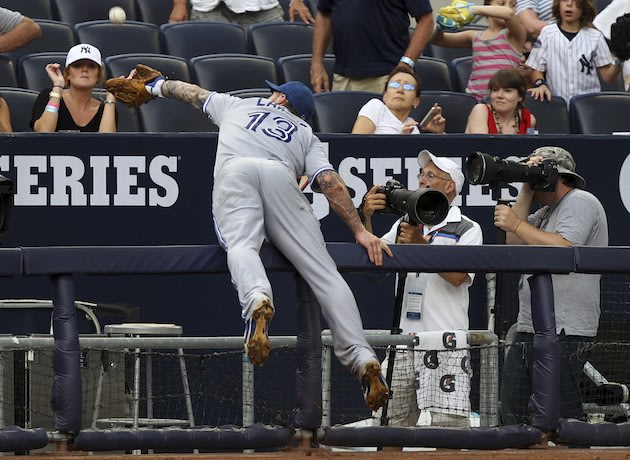
In an all too predictable scene from last night's Blue Jays game, Brett Lawrie leaped over a guard-rail, Superman-like, to catch a fly ball in Yankee stadium, banging his leg on a smaller railing as he came crashing back to the Earth. (Not that it really matters, but he didn't make the catch.) It doesn't look particularly ugly at first. And then it does with the benefit of a slowed replay and a better angle:


To quote the YES network commentators, Lawrie is one of those guys who "gives it their all". And according to Kevin Kaduk with Yahoo Sports, Lawrie "came away with...the respect of those who happened to be watching". But from all the comments I've read, Dirk Hayhurst comes closest to hitting the nail on the head...:


Let's make sure that this is perfectly clear: it isn't a coincidence that Lawrie is both a guy who 'gives it his all' and that he hurt himself, nor should we bemoan how unfortunate it is that such an accident and injury would befall someone who plays so recklessly. (Much less pay him respect for doing so.) It is, in fact, entirely foreseeable, and the injury is the direct result of his overly-intense style of play. And it shouldn't be encouraged.

Because it was also entirely avoidable. What's lacking from the discourse surrounding the injury is any discussion of, frankly, Lawrie's stupidity. Jumping into a concrete camera bay - a concrete camera pit, no less, because it looks like it's recessed from field-level by about 2 feet - is an undeniably stupid thing to do. And we shouldn't lament his accident, praise his vigour, or give him our "respect" when he does things that are unnecessarily dangerous. Instead, we need to hold him accountable, because in hurting himself he also hurts his teammates.

I'll admit that this looks cool, but, seriously,
it's also just completely unnecessary. Photo by the AP.

It's customary, when players are accused of the opposite problem - of playing too lackadaisically, of not running-out a ground ball, not playing hard when the game isn't close - to bench them. (Sometimes, this strategy is misused - like when a player fails to run on a play that's an automatic-out 99% of the time in an 8-0 game. But, sometimes, it makes a lot of sense.) And Lawrie, as a result of his own carelessness, is very likely to miss a game or two. That's maybe something, a de facto suspension, if you will.

But I'm not sure that's good enough. Players get benched for hurting the team because they don't try hard enough - why not bench Lawrie because he hurt the team by trying too hard? (No, seriously.) For his own good, even. Because if someone isn't able to convince him that, occasionally, it's just fine to ease up, he's not going to be long for this sport. And that's bad news for anyone and everyone who's associated with or simply likes the Toronto Blue Jays

Sunday, July 15, 2012

Irreverant sports blogging at its best

Over on Tom Tango's The Book blog, he recently posted a couple of links to the mid-season report cards at Lookout Landing, a Seattle Mariners blog. And he did this not because mid-season report cards are particularly informative or interesting - most of them are boring, unnecessary, and usually both - but because these specific report cards are. fucking. hilarious. Tango describes his writing thusly: "His takedowns are done in a good-natured way, not in a mean way.  He’s the baseball equivalent of Larry David.  And that’s a compliment to Larry David."


And he's right - this is amazing sports writing. So amazing, in fact, that I think even a non-fan can appreciate that this stuff is comic gold. Any of us who write about sports and are even occasionally clever or ironic - or just aspire to appearing to be clever - should probably take notes:

"The grades are also subjective, and I came up with them in two minutes, and if you disagree with any of them, you might consider paying less attention to these grades and more attention to your personal relationships which I can only imagine are actively deteriorating."

"[Franklin] Gutierrez came back from a long time off and was pretty good and then he got hit in the head by a pickoff throw that got by one of the most sure-handed first basemen in baseball. I'm not a believer in luck. Not at all, to the point where it actually irritates me when people act as if luck exists, and they either do or don't have it. It's nonsense and I can't stand ever setting foot within a casino. But if I had tickets to watch an archery competition, and I got to my seat, and I noticed Franklin Gutierrez was sitting one seat over, I would probably go home." [Neil: I actually laughed out loud at this one, which is always just a little bit embarrassing.]

"Strictly from a performance perspective, 71 pitchers have batted at least 20 times so far this year, and 20 of them have posted a higher slugging percentage than Munenori Kawasaki. Remember that extra-base hit that he lined? That was the one."

"Iwakuma's nickname is 'Kuma', or 'bear', and like a bear, he spent much of the previous few months hibernating. On the rare occasion he was awoken, he pitched like he was groggy and irritated. It's like the Mariners don't have the first idea how to handle a bear. They learned how to handle a moose."

"When healthy, [Shawn] Kelley's a guy who posts dominant ratios without ever feeling like a dominant pitcher, and for that reason he's probably doomed to a life of being under-appreciated. And a reliever in the major leagues bringing home piles and piles of money. I mean I guess he won't have the worst life."

Friday, July 13, 2012

Why I boo

At the risk of sounding totally miserable, I wanted to write a few notes about why I choose to boo some teams and athletes. I'm not sure that they're all good reasons, but I'm also not sure that they need to be.

Obnoxious Fans

Yankee fans! I have no idea where this picture is originally from...


For good or ill, this might actually be the number one factor that determines whether I come to hate a sports team. For instance, I can't stand the Yankees largely because of the fans they attract - people who think the team is entitled to a spot in the playoffs, to the best player available at the trade deadline, to the best free agents. And who pretend that the Yankees' ability to do these things with regularity is totally disconnected from political economy, and that it isn't a result of the team's absurd financial privilege. Similarly, I can't stand the teams that tend to attract fair-weather fans, even if it's really through no fault of their own. During the Euro Cup in Toronto, Italy and Portugal attracted droves of obnoxious, drunken jerks for no other reason than the 5 million bars and clubs that have moved into Little Italy and Little Portugal. But do I hold that behaviour against the teams? I sure do.

Favourites

Sad Tiger. Photo from Getty Images.


When I don't particularly care about a sport, I may actually have an interest in seeing the favourite play - if I'm going to watch something that I don't follow, it makes sense to see it played at the highest-level possible. But in most cases, I like to see favourite get bounced in favour of someone that's totally unheralded and/or unexpected. (Okay, so this has just as much to do with my love for the underdog. It still holds, though.) Also? I'm a big fan of watching hubris play out on the faces of professional athletes. (See: Woods, Tiger.)

Bad Owners/Stakeholders

Marlins' owner Jeffrey Loria, perhaps the most reviled man
in Montreal Expos' history. Photo by the Miami Marlins.


It's tough to like the Blue Jays when they're owned by the richest owners in baseball. And it's easy to hate teams when their owners, say, defend the use of Chief Wahoo (The Cleveland "Indians"), blame the fans for the team's lack of success (The Tampa Bay Rays), or manipulate the system and the local government in order to extract the most profit possible, with absolutely no intention of building a good team (The formerly Florida Marlins). Look: it's impossible to enjoy professional sport unless you're willing to accept that a bunch of old guys are becoming absurdly wealthy as a result. But the least we can ask is that they be honest and non-exploitative (well, less exploitative) about it, right?

Religious Right-wingers

Screen shot from C-SPAN, via Esquire.

A lot of people felt sorry for Albert Pujols when he got off to a terrible start this season. Not me. After learning that Pujols and Tony LaRussa attended a rally organized by Glenn Beck in 2010, I actually found myself hoping that his career would meet a swift end. (Of course, Pujols subsequently "explained" that he didn't know anything about the politics that were involved. Right.) Similarly, I instantly dislike anyone who insists that their performance has something to do with God's will, and isn't mostly random. (Because it is mostly random - that's why the L.A. Kings won the Stanley Cup.) And I dislike these sorts of athletes especially because they apply the standard so inconsistently - if, when they win, God wanted them to win, why is it that, when they lose, God never wanted them to lose? If winning is somehow proof that God approves of them, why is it that losing isn't taken to be proof of the opposite - that if God chose to make them losers, then he just doesn't like them very much?

Thursday, June 7, 2012

Is the Blue Jays' new draft strategy cause for celebration?

On Monday, Major League Baseball (MLB) held its (oddly in-season) amateur draft. This has become an important annual event for Blue Jays fans, who have had more to cheer for at the draft (because the team has spent buckets of money to purchase talented players other cost-conscious teams have shied away from) than during the rest of the season itself (since the Jays have not spent on the free agents that might have pushed them to contention). Sadly, this year, even this small pleasure has been snatched from us with the revised rules to the MLB draft that limit the amount teams are allowed to spend on players. Or so I thought. In fact, Blue Jays general manager Alex Anthopolous seems to have found a sneaky way around these pesky rule changes.

The devilish little fan version of myself masquerading as a Blue Jay perched on my shoulder tells me (chirps to me?) that I should be delighted by the new Blue Jays draft strategy. Has Anthopolous found a new market inefficiency ? Is drafting college seniors and then paying them a fraction of what MLB says they should get for their draft slot--in order to conjure enticingly over-slot offers for high-upside high school seniors--not exactly the sort of wizardry a fan should celebrate? Well, yes... and no.


Alex Anthopoulos. Photo from The Score.

This is why the fan on my shoulder has a distinctly satanic quality: over and over again, fandom produces and legitimises behaviour that would (I hope) otherwise be viewed as unethical. In this case, as it so often does, the fan lens conveniently transforms human, labouring athletes into objects that can be manipulated by a team towards the goal of winning. College seniors who want to play professional baseball have no choice when confronted by a low-ball offer but to accept it (unlike high school players or college juniors, who may reject the offer and re-enter the draft in a subsequent year). This means that they will labour for the team--risking debilitating injury--for an even lower wage than they previously would have received. These are precisely the sort of professional athletes who put the lie to the notion that athletes should not be seen as exploited given their multi-million dollar wages. Most professional athletes will have careers, like these college seniors, which pay little and leave them with damaged bodies.

In a sense, the Blue Jays have found a way to twist a system engineered to improve equity between teams of varying market sizes (previously, big market team paid big bucks to sign high-upside players with later draft picks who fell to them because poorer teams feared being unable to sign those players) into one that is even more inequitable for the players themselves. Top prospects will continue to reap huge signing bonuses, only now, this money will come from the pockets of other players instead of the coffers of mega-corporations. 

Clearly, this is a structural problem with the MLB slotting system more than an insidious product of Anthopolous' imagination. Nevertheless, as a human agent with considerable power, the Blue Jays GM has the ability to treat these young men right. That he won't is little cause for celebration.

Saturday, June 2, 2012

Errors in baseball: fix them, or just end them

We're in the fourth inning of today's Blue Jays game, and already there have been four difficult scoring-decisions that have perhaps all been called incorrectly:

  1. 2nd inning: A fly ball to CF is misplayed by a lightly-jogging Colby Rasmus, landing in front and slightly behind him. But he doesn't touch it until after it bounces once. It's called a hit.
  2. 3rd inning: A short-hopping line-drive - an absolute screamer- is hit directly at shortstop Mike Aviles. He misplays it and it hits his throwing hand. He recovers in time to make a throw to 2B, but it's too late to get the runner. It's called an error.
  3. 4th inning: A fliner is hit off the wall in RF. Jose Bautista plays it on the rebound, quickly double-pumps and throws to 2B. The throw isn't in time and the ball lands directly in front of Yunel Escobar, who misses it completely. Neither the 3B, Brett Lawrie, or the P, Kyle Drabek, is correctly positioned to back-up the throw and it goes past both of them, allowing the batter to advance to 3B. The throw is called an error, which means that the error is given to Bautista.
  4. 4th inning: A bouncing come-backer is hit to the pitcher. He jumps and knocks it down with his glove, causing it to bounce directly in front of him. He reaches out to bare-hand the ball after the first bounce, but this time it bounces off of his hand and rolls away. It's called an error.
Of the three calls, the only one that I would have definitely made myself is #2. It doesn't matter how hard the ball is hit or if it skips slightly to one side or another off the short-hop - if it's hit directly at you, then the expectation is that you must field it. [Update: Ha! In the 5th inning, they changed the ruling on this one to a base-hit. Hilarious that they would change the only one that I was confident they had gotten right.]

I can't make a call on #4 without seeing where the other fielders were positioned. If the shortstop is in position to field the ball, provided that the pitcher doesn't touch it, then it's an error; if it was likely to go up the middle, then the leaping pitcher probably shouldn't be given an error.

#3 is a bit of a strange one. The throw wasn't ideal, but Escobar erred in staying on the bag when the batter was going to be safe. He probably should have conceded the base and taken two steps forward to play the throw in the air. Likewise, the advance to 3B doesn't happen if either Lawrie or Drabek are covering the throw, so they've also erred. (Amazingly, then, the error was given to the one player who did the best job on the play.) There's an argument to be made, here, for one of two things: breaking with convention and somehow giving an error to all three of Escobar, Lawrie, and Drabek, or giving an error to the team but not to a particular player.

#1 is just dumb. The convention, again, is that it's not an error if an outfielder misses a fly ball, provided that he doesn't touch it until after it bounces. Regardless of why, though, Rasmus overran the ball and needs to be penalized for that. (Again, hilariously, he would've received an error if he had overrun it by a smaller margin and managed to just touch a small part of the ball. Like I said, dumb.)

An old photo of Rasmus dropping the ball for the Cardinals. Timeless.
Photoshopped by (or, at least, posted to) StL Cardinal Baseball.

But back to example #3. I've seen the team error suggested before, and it makes perfect sense, here, where the fault lies with at least three players, maybe four, and the error doesn't happen if only one of them does his job properly. The rules don't allow for that recognition, which is a shame - but it's also something that could be easily corrected, if anyone cared.

Or, conversely, they could just do away with the errors, and these attendant headaches, altogether. All there really good for is determining which runs are earned or not, anyway, and entire articles have been written about why ERA is misleading (because it even deems some HR unearned, which is madness and because ERA makes groundball pitchers look better than they are, to name just two reasons) and Reached-On-Error isn't random, but a repeatable skill at inducing errors by fielders (as demonstrated by the career-ROE leaders, whom tend to hit groundballs and are really fast runners).

Not that I expect either of those things to happen, of course.

Friday, June 1, 2012

Joey Bats follow-up: It looks like the time to worry is over

A month ago, I blogged about Jose Bautista's awful April, and asked what went wrong and whether it was reasonable to expect a rebound. You can click on the link for the full details, but I concluded with this reasonably optimistic sentence: "For what it's worth, this looks to me like a problem with discipline and patience - something that Bautista has been shown to have in spades."

May Bautista will smash April Bautista. Or wants to fly like an eagle.
Photo by Jim Mone/AP

It's probably a bit unfair and not entirely telling to compare April and May in order to see whether I was right - I'm comparing one rather small sample to another, after all - but let's look anyway. So, how did Bautista fare in May as compared to April?


Month PA AVG OBP SLG ISO BABIP BB% K% wOBA wRC+
2011 --- 655 0.302 0.447 0.608 0.306 0.309 20.2% 16.9% 0.441 181
2012 April 103 0.181 0.320 0.313 0.133 0.171 15.5% 11.7% 0.288 78
2012 May 120 0.257 0.342 0.552 0.295 0.247 10.8% 20.0% 0.382 143

It's not even close, actually. In April, Bautista was a replacement-level hitter; in May, he was a star. His 143 wRC+ makes him the 35th best hitter in MLB over the course of that month, and on the season he's a respectable 60th out of 160 qualified batters. Interestingly, too, his numbers in May are right around what was being predicted for him by the major forecasting systems in 2011, following his first monster year in 2010.

So, the power has come back - Bautista belted 9 homers in May, tying him with Edwin Encarnacion for 8th most - as you can see from his Isolated Power number being almost exactly what it was in 2011. And his BABIP is much closer to what it was in 2010, which accounts for why the batting average is around his career mark and not his 2011 number.

There are still two worrisome numbers, though - his walk-rate, while still good, has absolutely cratered. But Bautista hasn't walked as little as he did in May since his second season in MLB, which makes me think it's a bit of a fluke. And his K-rate has risen to above career-average territory, which is all the more surprising because it has been around 17% for the last two years. But, really, that's only a difference of 4 strike-outs over the course of a month.


Month PA GB/FB LD% GB% FB% IFFB% HR%
2011 --- 655 0.79 16.0% 36.9% 47.0% 15.2% 22.5%
2012 April 103 0.88 15.1% 39.7% 45.2% 21.2% 9.1%
2012 May 120 0.76 18.3% 35.4% 46.3% 21.1% 23.7%

The higher May BABIP seems to be a result of more line-drives; the fact that it's still rather low, though, would seem to be explained by the fact that he's still hitting infield flies at an alarming rate. Last time, I suggested that the problem, here, might be that he's not quite getting around fast enough on high fastballs. That might still be a problem - though less of one, obviously, because the home run-rate is back to last year's level.


Month PA FB SL CB wFB
2011 --- 655 50.3% 17.6% 11.3% 30.7
2012 April 103 59.6% 15.5% 6.9% -0.7
2012 May 120 49.2% 15.3% 10.1% 3.4

Here's where we start to find an explanation for these numbers, too. Bautista is seeing fewer fastballs, but hitting them much better than he was before. (Not nearly as well as the last two years, mind you, but back into 'excellent fastball hitter' territory.) He's also seeing more curveballs, cutters, and change-ups. This has me wondering if the pitch-selection in April suffered from some sort of selection-bias - if the Jays were simply seeing a lot of pitchers who through a lot of fastballs. Because you would think that Bautista's struggles in April, and the recent development of batting Encarnacion behind him, would lead to more fastballs, not fewer.


Month PA Con% Zone% O-Sw% Z-Sw% Swing% O-Con% Z-Con%
2011 --- 655 79.3% 44.4% 21.2% 57.9% 37.5% 64.2% 86.3%
2012 April 103 80.4% 47.4% 25.3% 54.7% 39.3% 77.2% 82.0%
2012 May 120 83.2% 39.8% 26.0% 55.6% 37.8% 71.6% 90.5%

And now we're back to the zone and contact numbers - which, I'll remind everyone, stabilize a lot faster than any of the other stats we've looked at.

Amazingly, while Bautista is striking out twice as much and walking much less than in April, he's also seeing fewer pitches in the strike-zone and swinging less often - he's back near his norm from the last two years, actually. And his contact rate has actually gone up. Those are really strange numbers to see in combination, and I can only assume that he's seen a really abnormal number of called third-strikes.

The O-Swing number have, unfortunately, not changed a bit. And the Z-Swing number has barely changed. So, while pitchers have clearly approached him differently in May, Bautista hasn't actually changed his approach. The difference, though, seems to be in his contact-rates - he's missing more often on outside pitches (which is a good thing) and making contact more often on strikes (which is also a good thing). What's unclear, though, is whether those contact rates are the result of April's bad luck regressing to the mean or the result of Bautista doing something differently.

So, the end result is this: in May, pitchers returned to pitching Bautista like they did last year, and they've paid for it. Bautista continues to swing much like he did in April, but both his O- and Z-Contact rates have swung dramatically in his favour.

On the plus-side: Given his history - and the fact that May aligns far better with his 2010-11 numbers than does April - it would seem to me that the May Bautista is the one we'd expect to see the rest of the way.

On the minus-side: His swing and contact profile, while improved, still look markedly different from 2010-11. (Well, they look somewhat like 2010, but not much like 2011.) It's looking increasingly likely that that Bautista won't re-emerge.

Saturday, May 26, 2012

"The Catch", 2012 edition

Some moments in sport defy description and render analysis redundant, if not totally unnecessary. For instance, this.

100% not photoshopped. Photo by Bill Wanger/The Daily News

If you want to see the video, which is equally impressive, you can find it at the end of this article.

Sunday, May 20, 2012

Live-Blogging the Blue Jays Broadcast: Game 42

[I'm starting this one a bit late, and missed most of the first inning!]

 
1st inning

Pat: "Batters are hitting over .500 against [Dillon Gee] when they swing at the first pitch."

There are all sorts of problems with this statement. First, Pat means to say that they're hitting over .500 when they put it play or hit it out of the park. That number doesn't account for instances where the batter misses or fouls the ball off. Also, only 15 at bats vs. Gee have been resolved on the first pitch. That's hardly evidence of, well, anything.


2nd inning

Buck: "The Mets, by starting the runner, stay out of the double-play."

One of my pet peeves about Buck and Pat is how they never critique the decision to hit-and-run. The problem with hit-and-run is that it's often a bad idea - it forces the batter to swing at pitches that he wouldn't otherwise swing at, and to take slapping contact-swings rather than full, proper ones. (It's tough to prove, mind you, but the general consensus is that it's a toss-up, at best. And that the degree to which it is a good idea depends, substantially, on the quality of the base-runner.)

Buck: "[Henderson Alvarez]'s a little rushed. He's always quick to the plate."

Alvarez has been averaging more than 20 seconds between pitches this year. That's above average, but only by a second or two. (Among starting pitchers, he's almost exactly average.)

Buck: "I think there are more good teams in the American League than in the National League right now."

I'm not sure that's an "I think" situation - you can pretty easily prove it. Buck went on to talk about win-loss records, which makes no sense - prior to Interleague play, which began on Friday, the leagues had only played amongst themselves, so the overall record in each league would be .500.

Buck: [after Gee throws a first-pitch breaking ball] "Gee picked up that the Blue Jays are looking to ambush on the first pitch."

That's probably a good read. He just watched a rookie hit a liner off a first-pitch fastball, so it's reasonable for him to assume that they're looking for it. (Also, his fastball is terrible. So, the Jays should look for it.)


3rd inning

Buck: [in reference to a chart that shows the Blue Jays have the best starters' ERA in the AL] "We mentioned how well the starting pitching has been playing. ... The Blue Jays also have 19 starter wins. They're tied with Texas for second."

The weird thing, first, is that they're graphic shows a 3.33 ERA for starters, while Fangraphs says 3.16. Dunno what accounts for that difference. 

But this is an interesting topic, because those same pitchers - who have the best ERA in the AL and 4th best in the Majors - have posted a very bad FIP: at 4.49, it's 11th in the AL 26th overall. (SIERA says 24th; tERA says 25th/) So, that's a huge disagreement between ERA and the advanced metrics. Usually, the numbers are quite close - only one other team has a 1.00 difference, and the numbers are quite close for most teams - which implies that the Jays' fielding has been exceptional (which is another interesting argument), that their pitchers are amazing with runners on base (which has been shown to be very rare for individual pitchers, much less a whole team), or that they've been very, very lucky. My guess? When all the metrics say this starting staff if below-average and should have an ERA over 4.00, we're probably going to see a regression to that range over the rest of the season.


4th inning

Buck: "Nick Markakis and Adam Jones have been doing a great job."

Markakis - .258/.335/.440, for a 118 wRC+ - has been better than I thought, though not especially "great". That's basically how he's compared to league-average through his entire career, which is "good" but nothing amazing. (Considering, especially, that the most common assessment of Markakis is that he's failed to live up to his potential.) Impossible to argue with his observation about Adam Jones, though.

Buck: "[Kelly Johnson]'s predominately a pull-hitter."

But the graphic they showed seemed to be saying the opposite - less than 40% of his balls-in-play were pulled, which is equal to the number of hits to center. Actually, I have no idea what that graphic was actually showing - it showed 36 balls in play, but Johnson has put more than 100 balls in play. Weird. I can only guess that it was actually fly balls plus non-fly home runs. (Assuming that three of those homers were classified as line-drive and not flies.) That actually makes it seem like he's even less of a pull-hitter, then, since hitters tend to pull in the air and put balls on the ground when they push.


5th inning


Buck: "What makes Wright such a good hitter?"
Pat: "...A good RBI-man."

Good RBI-man means that he always hits 3rd in the line-up, where even an average hitter is virtually a lock for 90 RBI if he plays every day. That said, Wright fell well short of 90 in 2009, and would have only had roughly that many RBI last year, if your project to fill the time he was injured. (To be fair, though, the Mets were absolutely terrible on offense in 2009. But Buck and Pat don't talk about how important "opportunity" is to racking up RBI. As everyone who reads about RBI would know, RBI are almost entirely a product of a) the quality of the hitter, regardless, and b) how many base-runners you have.)


Hmm... Buck and Pat just don't seem to be saying anything, anymore. Probably, in part, this is because the Jays are losing 6-2 and don't seem to be doing much on offense. I may just graciously bow-out right now and promise to stick with it next time...

Friday, May 18, 2012

The logic of baseball suspension length, or lack thereof

First, a disclaimer: This blog is not going to turn into the Brett Lawrie Blog, Sometimes Covering Other Topics. (Even though, right now, it might seem that is!)

Second, an additional disclaimer: I have been harshly critical of Lawrie in the two posts that I've devoted almost entirely to him. I'm not certain that I would like him much in conversation, but I actually do really enjoy watching him play. He's exciting to watch, in part because he's already a good player and in part because he's always putting in maximum effort. The enthusiasm he displays in every moment is, I think, unparalleled in baseball, and you can feel it rubbing off on the rest of the team. And the series of handshakes that he's designed with each of his teammates are ridiculous, but in a good way.

But, the guy who seems to pull off something like every second game...


...is the same guy who did this a couple days ago.


Understandably, he was suspended. Because as much as we all want, to put it euphemistically, to lose our shit when a call doesn't go our way - and, in fact, it was two consecutive blown calls that led to Lawrie's "Hulk Smash!" explosion - it was a terrible idea. (I know that the Pitch F/X data that's been circulating suggests that the pitch barely missed an inch high, but their range makes no sense. I can't imagine any umpire calling a pitch that's more than 3 and a half feet high a strike, much less against a 6 foot tall hitter who's a half foot shorter in his stance.)

The culture of the game is to blame, too, of course. Players and umpires are all but encouraged to get in each other's faces and scream. The system by which umpires are evaluated and made accountable for their mistakes are entirely opaque. And it should be very easy to develop a program that can call balls and strikes with better accuracy. Baseball has made no effort to address any of those things.

So, what I wanted to look at is where the punishment - four games - fits in relation to other suspensions, across various sports. In part, I want to see whether there's a consistent logic applied within baseball and across various sports; in part, and assuming that there is some consistency, I want to see if Lawrie's punishment fits it. Following from this starting point, then, I pulled together this list.

  • 1 game (<1% of season) - Bobby Bonilla, 2001 (slapping another player)
  • 2 games (1%) - Milton Bradley, 2009 (bumping an umpire)
  • 2 games (1%) - Marlon Anderson, 2007 (throwing helmet toward home plate)
  • 2 games (1%) - Lance Berkamn, 2007 (throwing equipment on field)
  • 2 games (1%) - Roberto Alomar, 2005 (throwing glove in direction of umpire)
  • 3 games (2%) - Jonathan Papelbon, 2011 (bumping an umpire)
  • 3 games (2%) - Burke Badenhop, 2009 (hitting Orlando Hudson with a pitch, after a warning)
  • 3 games (2%) - Albert Belle, 1993 (charging the mound after being hit by pitch)
  • 4 games (2.5%) - Brett Lawrie, 2012
  • 4 games (2.5%) - Moises Alou, 1995 (participating in bench-clearing brawl)
  • 5 games (3%) - Cole Hamels, 2012 (hitting Bryce Harper with a pitch)
  • 5 games (3%) - Yadier Molina, 2011 (bumping an umpire, with incidental spit)
  • 5 games (3%) - Josh Beckett, 2009 (intentionally throwing near Bobby Abreu's head)
  • 5 games (3% ) - Roberto Alomar, 1996 (intentionally spitting on umpire) 
  • 50 games (35%) - Delmon Young [International League], 2006 (throwing bat at umpire)
  • Banned for life - Jose Offerman [Dominican Winter League], 2010 (punching umpire in face)

The first thing that's made clear, here, is that baseball treats violence (and the threat of violence) against players and umpires differently. Charging the mound with your fist cocked is given the same punishment as bumping the beak of your hat against the umpires forehead. The distinction makes sense, though; you need to allow for the possibility that things will get heated between opponents, but you can't allow players to think they can intimidate the officials. (I've also heard the legal argument - of "assumed risk" - that says baseball players concede implicitly that the job is potentially violent and injurious, while umpires do not.)

Jose Offerman charging the mound in a AAA game. He hit the catcher
in the head and give him a career-ending concussion. Is that "assumed risk"?
No photo credit available.

Second, baseball has been all over the place with the lengths of its suspensions. There are three different suspension lengths for three different umpire-bumping incidents, and Yadier Molina's bump-and-spit combo (where I'm probably being generous with "incidental" spit) got the exact same length as Alomar's unmistakably intentional spit 15 years ago. There should probably be some sort of standard here, but there clearly isn't. About the only thing that they can agree on is that pitchers should get about five games if they admit, or are proven, to have hit a batter intentionally. But this has less to do with how the infraction compares to other forms of violence than it does to the fact that starting pitchers only play once every five days.

And here are the comparisons to some recent rulings in other sports leagues.

  • 20 games (24% of the season) - rulebook suspension for intentionally tripping a referee [NHL]
  • 25 games (30% of the season*) - Raffi Torres [NHL], 2012 (blindside check to Marian Hossa w/head contact)
  • 15 games (39% of the season) - Dani Benitez [La Liga], 2012 (throwing water bottle at referee)
* the NHL's playoffs, like the NBA's, are so long and include so many teams that it's probably not fair to assign a percentage

The soccer suspension is completely out of whack with anything else that I've ever seen. It's actually maybe the nearest to the Lawrie incident, insofar as both throws seemed to be expressive of frustration and not an intent to injure. On the other hand, Benitez was trying to hit a referee, while Lawrie threw his helmet with such force that the possibility of accidental injury was greater (though still small). But that length is just nutty. And I've included the Raffi Torres incident in order to illustrate, again, the difference in punishments when we're talking players vs. officials. And while the NHL isn't anywhere near La Liga, when it comes to punishing players who lash out at referees, I think it's fair to say that they both take is a lot more serious than baseball does.

I don't have any solid conclusion to end with. Even though baseball's punishments appear to have no strict system of application, they're all so short (mostly between two and five games) that it's difficult to argue that Lawrie's suspension is surprising or inconsistent with past practice. The real question, though, might be whether baseball's practice is a good one, because Lawrie's actions would certainly earn him a longer suspension in either the NHL or La Liga. But that's something that all of baseball would need to start thinking about.

Wednesday, May 16, 2012

Round Table #1: Josh Beckett's back-injury and golf

[Context: Two weeks ago, Josh Beckett was scratched from a start due to back-tightness. Last week, it was revealed that he subsequently went golfing. In his own defense, Beckett explained that he often golfs on off-days and it's never been an issue before. For those keeping track, Beckett was also the reputed "leader" of the group of Red Sox at the center of last season's drinking-beer-in-the-clubhouse-during-games controversy.]

Photo by Jeff Haynes, Reuters


Derek:

Insofar as Beckett's pursuit of (drinking and) golf interferes with his job, it is assuredly a problem.  I mean, if golf (and/or alcohol) interfered with my job, I'd be fired and Beckett makes far more money (for a far less meaningful 'job').

That said, proving that his baseball troubles stem from disinterest and/or distraction is another matter entirely.  Thus, the converse also holds: insofar as they are not interfering with his ability to do his job, the public outcry is potentially unfair.  More often than not claims of disinterested play seem to come about in bi-directional fashion (see Yunel Escobar).  That is, teams with rules/standards/practices that don't connect well with a given player's demeanour (much like management disconnect from staff in many workplaces) fails to generate a substantial return on investment.  Often when struggles arrive, press, fans, managers grasp at straws:  Beckett is struggling at baseball while golfing a lot, therefore golf must be the problem.

However, Josh has every right to golf and perhaps we should simply stop at the first clause ("Beckett is struggling at baseball.")  Golf, alcohol, personal problems aside, when most players struggle to this degree changes are made (trades, demotions, placed in bullpen or on DL, etc) but it seems to me that placing the blame on Beckett's non-baseball activities does little to resolve the problem.

Photo by Jim Rogash, Getty
 
Nathan:

It is tempting to unite with Boston fans and media in indicting Josh Beckett for playing golf during the season, particularly on the heels of last year's chicken and beer fiasco. After all, pro athletes like Beckett make a relative fortune playing a game many of us pay to play in our leisure time. Tempting as it might be, however, it isn't fair.

The disciplinary structure of high performance sport instructs athletes to understand their bodies as machines. That is, it encourages a dualistic approach that separates the mind from the body and positions the latter as inferior and thus subordinate to the former. This is an instrumental approach to the body that makes it possible to treat it as a weapon in violent sports that can inflict harm on the other, and, slightly more benignly, as a tool to be manipulated by the mind in others like baseball. Part and parcel of this dualism is the notion that the body must be cared for like a machine--it must be fed, watered, and conditioned to achieve optimal performance. Like a machine, however, it also means that the body is disposable. It is a means to and end, and that end is ultimately more important than the costs accrued to achieve it. Thus, the athlete is exhorted to destroy the body in the quest to win for the team, and for the fans who vicariously find meaning through the team.

So, why this abstract meditation on the culture of high performance sport? What does it have to do with Beckett? My case is that athletes like Beckett should be encouraged not to see their bodies in such instrumental terms. By playing golf, Beckett reveals a more playful understanding of his body. His lack of concern over how to optimize its performance suggests that he has not been entirely socialized into this damaging culture. While this may mean he suffers injury in the short term, it may also mean that he is less willing to subject it to extreme forms of harm over the long haul. It also models for other, younger, aspiring players that there are different ways to approach sport. Like, for instance, as if it was just a game.

No credit found for this one, unfortunately!

Neil:

I'm a big fan of Dirk Hayhurst - relief pitcher (former Blue Jay!), blogger, memoirist, and fantastic Tweeter - and, in thinking about Beckett, I'm going to draw a bit of inspiration from his own ruminations on this topic.

A career-minor leaguer, Hayhurst has made a whole 25 appearances at the big-league level, (and, barring a miracle, won't make another) and is unapologetically honest when it comes to talking about the stresses and pressures that come with being a pro athlete. So, when Hayhurst is asked to either tell kids that they should 'play for the fun/love of it', or is criticized by fans/parents/coaches because his writing is too serious and shows that he doesn't just 'play for the fun/love of it', he inevitably disappoints them. Because, for Hayhurst, it isn't particularly fun - it's his job, (both the baseball and the writing that it inspires) he has responsibilities to his team and the fans, and it's how he feeds his family. But he also talks about the moment where pros admit to 'not caring anymore', and by this he doesn't mean that they stop playing hard - he means that they accept that their careers will eventually end and they need to have something more going on in their life.

So, where am I going with this? I can't help but feel that some of the animosity has to do with the bizarre expectation that athletes must be 100% committed to their sport, every single moment of every single day, at least during the season. We have this weird expectation of pro athletes that suggests that proper "discipline" or "focus" requires complete devotion, if not unhealthy obsession. But playing other games, showing interest in other things? This is good. Beckett needs to be doing these things for himself, owes it to himself to live a balanced life and develop a wide range of skills and interests, because his baseball career will be over before the end of the decade.

But the baseball job? Like Hayhurst says, Beckett isn't just doing that for himself. And to the extent that golf could easily lead to an injury that affects his ability to pitch, it's a bad idea. (It's possible that Beckett has a technically sound golf swing and that his swing coach and doctor are in agreement that the muscles he uses in his swing are not the same muscles that he injured pitching. But I find that kind of forethought very unlikely.) It has nothing to do with optics, (although, certainly, it does look bad) and everything to do with living up to the responsibility he has to others - his family, his teammates, the people of Boston. (And, I begrudgingly admit, to the guys who directly employ him. They do, after all, owe him another $45 million, give or take a couple million bucks.)

Sunday, May 13, 2012

Chief Wahoo and racist myth-making: an FAQ, of sorts

A couple weeks ago, I read a really nice piece by Peter Pattakos in the Cleveland Scene. (You should probably check it out.) In it, Pattakos talks at length about the Cleveland Indians' mascot, Chief Wahoo, the origin of the "Indians" team name, and the politicking that has surrounded the two for the past few decades. Needless to say, the author is soundly on-side with the anti-Wahoo folks who rightly deride it as horribly racist and unnecessary. And, needless to say, the comment thread quickly filled-up with people - some of whom obviously hadn't actually read the article - who came up with all sorts of, let's face it, patently stupid defenses of Chief Wahoo.

So, without further ado, here are some of those myths - some stupid, some not so much - debunked in what I hope is a much easier-to-consume form.


Myth #1 - The baseball team was given the name "Indians" in 1915 out of respect for Louis Francis "Chief" Sockalexis, a Native American who played for the Cleveland Spiders in the 1890s.

Well, actually... the name was meant to evoke the stereotype of the savage, blood-thirsty Indian of the then-recent Indian Wars.

Peter Pattakos covers this one adeptly in the article, but it bears repeating. To quote Joe Posnanski, "Why exactly would people in Cleveland — this in a time when Native Americans were generally viewed as subhuman in America — name their team after a relatively minor and certainly troubled outfielder?" Sockalexis wasn't even liked by the Cleveland fans, who were known to shout racist slurs and throw garbage - and this guy played for the home team. The Indians' nickname was, in fact, originally given to the team by the 1890s journalists who jokingly (that is, mockingly) referred to Sockalexis' entire team as "Indians". When the team adopted the name at the behest of the next generation of journalists in 1915, contemporary stories include zero references to Sockalexis but numerous mentions of racist stereotypes, like the suggestion that the team will be "on the warpath all the time, and eager for scalps to dangle at their belts". But don't take my (or Pattakos') word for it:

From The Cleveland Plain Dealer, 1915.


Myth #2 - Chief Wahoo represents old-time baseball and childhood memories of trips to the ballpark, not actual Native Americans.

Well, actually... it can be, and is, both about old-time baseball (and all the baggage that old-time baseball carries) and actual Native Americans.

First, nostalgia for its own sake is always a pretty weak argument. Don't just say that it's good because it's old and familiar and you remember it fondly. Resorting to an 'it's tradition!' argument doesn't actually explain why it's a good thing. Second, the way that nostalgia idealizes the past is especially problematic, here. When we choose to remember or recognize only the good, we have to conveniently ignore the bad. Like, in this example, the memory of the shitty treatment given by the city of Cleveland to Sockalexis, their supposed inspiration. Because, let's remember, old-time baseball was also about excluding or alienating everyone who wasn't white.


Myth #3 - Whether you see a racist caricature or not is a matter of individual perception. It's all relative, so don't force your opinions on me.

Well, actually... just because it's relative doesn't mean that every opinion is equal, especially when the people who don't see a caricature are often operating from a position of blissful ignorance.

Whenever someone uses "relative" this way, they deserve to be slapped, because it's being used in an incredibly reductive way in order to imply that if something isn't a fundamental law of the universe - ie. the definition of "racist" or "offensive", as opposed to the chemical composition of water - then it's entirely up for grabs. Only, that's not actually true, and history and social consensus can't just be dismissed without consequence.

Take, for instance, the colour blue. Now, I could start referring to the colour blue by the name "red". And you might find that endearing, at first. But you would probably tire of it, eventually, and you might even grow concerned if I didn't stop, and either start correcting me (because I'm either colour-blind or, I suppose, an idiot) or refer me to a doctor (because I've lost my mind). In any case, even though the combination of the colour and its name are totally unmotivated and relative, that doesn't mean that they can be ignored at will and without repercussion.

So, whether you see a racist caricature has a lot to do with whether you're conscious of racist caricatures and their history - you don't need to know what a Sambo character is, or what they look like. I don't think that you need to be aware of how degrading Sambo-type caricatures were intended to be, how much pain they caused, and exactly what defined their appearance. Because you can just look at Chief Wahoo and the Indians logo and easily recognize that this isn't a flattering representation: knowing nothing else, you can be certain that it's unrealistic, pretty sure that it's comedic, and relatively confident that it's mocking.

Aaron Sechrist's comparison of Chief Wahoo to a Sambo caricature


Myth #4 - People who are offended by Chief Wahoo take themselves too seriously. They should worry about more important things.

Well, actually... "important" is relative, too.

If you identify as a member of a group that has historically been mocked and/or villified - and made to feel less than human for it - you'd probably be sensitive, too, when a pro sports team continues to shove that in your face and tell you that your opinion and feelings don't matter. What's not important to you, personally, could be incredibly important to someone else.

So, there's an empathy problem here - a lot of white fans, for instance, are able to say this because they can't relate to the feeling. Which is probably why someone made this logo:

T-shirt from Shelf-Life Clothing Co.

And let's be careful with our use of the word "important", especially to avoid being inadvertently ironic. Because if we're saying it isn't important because people are children are starving somewhere, then surely a bat-and-ball game played by millionaires, who are employed billionaires, isn't important either, right? And if a ball game isn't important, then neither is Chief Wahoo - why not just change the damn logo?


Myth #5 - But some Aboriginal/Indian/Native people are fine with it, so it must be okay.

Well, actually... no one person, or group of people, can speak for everyone. And we aren't always conscious of the ways in which we're being oppressed.

But it's also true that we ignore or excuse a lot of inequality, even when it affects us directly. Purely as a defense mechanism, we don't want to believe that racism or sexism or homophobia exists. Even when we're victims of these processes, we often don't see them - in part, because seeing them would require us to see that we're complicit in processes that similarly discriminate against other people and benefit us.

And if that doesn't convince you... just think of every time you played pick-up sports as a kid, where your team lost the argument if one of your teammates agreed with the position of the other team. Regardless of the facts, that was always the deciding factor. It was dumb, but it was forgivable, too, because you were all just kids and your solution didn't necessary have to be logical. Adults, though, need to be held to a higher standard.

 
Myth #6 - If the logo is racist, then that makes everyone who likes it racist. So, you're calling me a racist.

Well, actually... plenty of people unknowingly do and say racist things all the time, often without any awareness of it.

My favorite anecdote on this topic came from the first summer that I worked in a government office. One of my co-workers, who was reviewing my work, said that I didn't have to worry because, and I quote, "I'm not gonna Jew ya." And she had no idea that the verb, 'to Jew', had anything to do with Jewish people. No, seriously. (In her defense - I grew up in Sudbury, which, according to the 2006 census, is 93% white. Ignorance of obviously racist things is pretty common.)

The real problem is when you know the arguments, you've heard the evidence, and you just ignore it all.


Myth #7 - The logo's not racist.

Well, actually... if you're still saying that, I'm hoping it's because you didn't bother to actually read this article. (Or that you're illiterate.)

Friday, May 11, 2012

Solving the beanball problem

Okay, so my title is begging the question: is there actually a "beanball problem" in baseball? I'm taking it for granted that there is, and that you agree with me. (This is inspired, of course, by the Cole Hamels-Bryce Harper controversy from less than a week ago.)

Hamels explained that he threw at Harper because the latter is a rookie, and because
Hamels' plays "old school". Reportedly, Hamels also kicks opponents in the groin and grabs
runners by the belt, just like Ty Cobb did. Old school! Photo from The Washington Post.

The hit-by-pitch in baseball is, to some extent, unavoidable. In the last 60 years or so, Major League Baseball has averaged a bit less than 0.5 hit batters per game. (And that 0.5 includes both teams - so individual teams' pitchers hit one batter every four games, and one of their own batters is hit by opposing pitchers once every four games. And that includes intentionally hit batters, which surely inflates the number a bit.) Even pitchers who have a reputation for being particularly wild or willing to throw inside only hit one batter every 20 innings - and normally, 20 innings would be spread over three starts.

So, what I'd like to suggest (y'know, for all those baseball executives who read this blog) is a yellow-card/red-card system for pitchers who hit batters. It would look something like this:
  • if you hit 2 batters in the same inning, you earn a red-card and are immediately ejected
  • if you hit 2 batters in different innings of the same game, you earn a yellow-card
    • [assuming that you don't later earn a red-card, that yellow-card stays with you for the next 7 days]
  • if you hit a 3rd batter in the same game, you earn a red-card and are immediately ejected
  • if you enter a game while having a yellow-card from a previous appearance, your 1st hit batter  extends it for another 7 days
  • if you hit a 2nd batter in the same game, you earn a red-card and are immediately ejected
  • every red-card is subject to automatic review to determine whether an additional suspension is warranted
  • after your first red-card of the season, every additional red-card carries an automatic 7 day suspension, plus a review to determine whether an additional suspension is warranted

I think that covers the ground that it should cover, but I might be missing something. The idea, though, is to provide enough of a penalty that pitchers might try a little harder to avoid hit batsmen, while at the same time not doing so much that pitchers would be afraid to throw inside. (Unless, of course, they have a yellow-card against them. In which case, they probably should be a bit afraid to throw inside. But that's just how penalties are supposed to work.)

There's one obvious gap in my logic, though, which is that it might actually incentivize batters to lean into a pitch, or simply not get out of the way. I'd like to think that most batters aren't that dumb - letting an 85-95 mph ball hit you, in any part of your body, is probably a bad idea. At the same time, we know that happens, and some batters - I'm thinking of Larry Walker - were particularly good at "turning away" from the ball in such a way that they actually increased the likelihood that they would be hit.

For that reason, any beanball that resulted in a yellow or red-card would be subject to video-review after the fact - and the card would be rescinded if the reviewer found that the batter didn't actually make an effort to get out of the way. (Also? Let's starting calling batters out when they don't actually try to get out of the way. Because I'm not sure that I've ever seen an umpire do that.)

Tuesday, May 1, 2012

Joey Bats: Seriously, is it time to start worrying?

In what has become a discomfortingly familiar sight, Bautista pops out last night. Photo by Nathan Denette.

Jose Bautista is off to an awful start. But don't take my word for it - here's a simple comparison of his ratios from the past few years:

PA AVG OBP SLG ISO BABIP BB% K% wOBA wRC+
2009 404 0.235 0.349 0.408 0.173 0.275 13.9% 21.0% 0.339 102
2010 683 0.260 0.378 0.617 0.357 0.233 14.6% 17.0% 0.422 166
2011 655 0.302 0.447 0.608 0.306 0.309 20.2% 16.9% 0.441 181
2012 99 0.190 0.333 0.329 0.139 0.179 16.2% 11.1% 0.301 88


In every category but K-rate, (strangely, but more on that later) Joey Bats' numbers have taken a nose-dive. He's walking less than last year, his batting average on balls in play is absurdly (and unsustainably, thank god) low, and his isolated power is actually below league-average. And overall - and this is what you see in those last two columns, weighted on-base average and weighted runs created plus - he's about 10% below league-average on offense. The Bautista that we see in 2012 looks nothing like the one from 2010 or 2011 - he doesn't look much like the one from 2009, either, but if we were compelled to choose the best comparison...

"But", you're saying, "this is a small sample-size. If his BABIP were closer to his career average (of .273) and just 1 or 2 deep fly-outs had left the park, we wouldn't be worried at all!" And you're probably right. But his BABIP has been low and he does only have 5 extra-base hits (after posting 92 and 69 in the past two years), so let's see if we can find an explanation. First, we'll check out the batted-ball details:


PA GB/FB LD% GB% FB% IFFB% HR/FB
2009 404 0.98 16.7% 41.3% 42.1% 10.4% 12.3%
2010 683 0.57 14.4% 31.1% 54.5% 14.9% 21.7%
2011 655 0.79 16.0% 36.9% 47.0% 15.2% 22.5%
2012 99 0.85 13.7% 39.7% 46.6% 20.6% 8.8%


Again, given the caveat that these are small samples, it looks like some sort of explanation is starting to emerge, and it reconciles well with what the eyeball-test tells me - Bautista just isn't getting good wood on the ball, and is either driving it into the ground or blasting it sky-high. (In Sunday's game, he hit three IFFBs in one at-bat - one fell foul because of a miscommunication, one fell just a couple rows into the stands, and the last was finally caught by Seattle's shortstop.) His line-drive rate is noticeably down, his ground-ball rate is rising to pre-2010 breakout levels, and he's hitting harmless pop-ups at a really alarming rate. And when he does hit flies, they just aren't leaving the park. This also explains a lot of the BABIP, by the way - the expected batting average on LDs is about .700, while the expected average on IFFBs is almost .000.

Bautista wonders about the BABIP on bunts - hint: it's not enough. Photo by Mike Cassese.


So, why is this happening? Is he doing something different? Are the pitchers doing something different? Based on the next spread of numbers, it seems like that it's a bit of Column A and a bit of Column B.

First, the pitches he's seeing:


PA FB% SL% CB% wFB
2009 404 59.9% 14.6% 10.7% 4.1
2010 683 49.5% 19.3% 12.7% 38.9
2011 655 50.3% 17.6% 11.3% 30.7
2012 99 59.6% 15.5% 6.9% -0.7

This is where it starts to get interesting - pitchers don't seem to be afraid to throw fastballs to Bautista anymore. A typical MLB batter sees around 56% or 57% fastballs, but Bautista's 50% in 2010-11 was the 6th fewest among qualified batters - a number beaten only by other sluggers like Ryan Howard and Josh Hamilton. A 60% rate, though puts Bautista in the company of guys like Michael Bourn and Michael Cuddyer. Again, this seems to jibe with the eyeball-test (and, amazingly, with Pat Tabler's analysis) - pitchers who were previously afraid to throw the high-heat to Joey Bats are now throwing it routinely.

But they would only throw it if he wasn't hitting, right? And you can see that he's not hitting it well in that last column - the one that shows that Bautista has posted a negative run-value on fastballs in play, after two seasons where he hit fastballs better than all but two other players. So, let's look at what Bautista is or isn't doing with the bat...


PA Contact% Zone% O-Swing% Z-Swing% Swing% O-Contact% Z-Contact%
2009 404 80.1% 52.3% 17.5% 55.6% 37.5% 59.7% 86.0%
2010 683 80.5% 48.5% 22.0% 60.0% 40.4% 66.1% 86.1%
2011 655 79.3% 44.4% 21.2% 57.9% 37.5% 64.2% 86.3%
2012 99 80.4% 47.4% 25.3% 54.7% 39.3% 77.2% 82.0%

I could probably have started with this one chart and referred only to this one chart. That's because plate discipline is the one instance where the sample-size may not be an issue - swing and contact-rates in baseball stabilize much faster than anything else. (Of course, I'm going to break those rates down into sub-sets, which makes it a little questionable, again. Sue me.)

Now, Bautista's Contact% number looks pretty solid, but if you look at the other columns it's also a misleading number. Because, while the overall number looks consistent and encouraging, its components have changed pretty dramatically.

First, Bautista is swinging much more often at pitches outside the zone (O-Swing%) and less often at pitches inside the zone (Z-Swing%). Bautista's numbers in both columns are still well below-average (which are around 30% and 65%, respectively), because he's an exceptionally patient hitter, but the trend is obviously troubling.

Second, and perhaps more indicative of his problems, Bautista's contact rate inside the zone has dropped by a pretty sizable margin, while, again, his contact rate on pitches outside the zone has increased dramatically. Bautista has always made contact in the zone at a slightly below-average rate, but that's not surprising - power has a significant negative-correlation with contact, so power hitters do tend to whiff at a high rate. More remarkably, though, he used to miss outside pitches more often than league-average (68%), but is now making contact well above that average.

Especially when you think about how power and contact correlate, Bautista's contact rates are a bad development that goes a long way toward explaining the early season problems - if Bautista is making more contact with less hittable pitches, then it follows that the balls he puts in play will be more poorly hit. Not to sound like I'm hitting the panic button, but when I saw these numbers I was reminded of another power hitter who's infamous for his plate discipline and tattooing fastballs, but saw his Z-Contact% drop slightly and his O-Contact% increase dramatically last year, resulting in a complete inability to do anything useful against fastballs - Adam Dunn.

No one wants to be compared to 2011's Adam Dunn. Not even Adam Dunn. Photo by Jerry Lai.

So, where does that leave us? My quick and dirty summary is this: Bautista has to stop swinging at pitches outside the zone. Unless you're Vlad Guerrero in his prime, putting O-Zone pitches in play is deadly to a batter's production. And, really, it's not like he even has an excuse for chasing bad pitches out of the zone - he's seeing more fastballs in the zone than he has in years! (Less helpfully, I'd add that he needs to start hitting fastballs, again.)

No, all is not lost - not even for Adam Dunn, whose 2012 peripherals and production look a lot like his pre-2011 numbers, and is also back to destroying fastballs. In all likelihood, Bautista just needs to adjust his approach ever-so-slightly, to something more closely resembling what he did over the past two years. For what it's worth, this looks to me like a problem with discipline and patience - something that Bautista has been shown to have in spades.